Tower Defense Games: A Practical Guide to Placement, Upgrades and Waves
How tower defense games work, why placement matters more than upgrades early on, and a repeatable approach for difficult waves.

Tower defense is one of the oldest and most satisfying mobile genres. Enemies travel along a path, and you place towers that attack them before they reach the end. The rules are simple, but good play depends on understanding a few principles that apply to almost every tower defense game, from classic fixed-path designs to merge-based variations.
The core loop
Every tower defense game follows the same basic cycle:
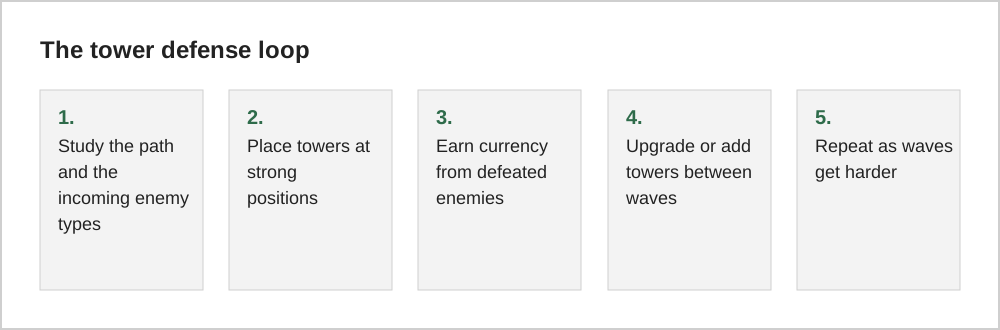
The interesting decisions are where to place towers, which towers to build, and when to spend currency on upgrades versus new towers.
Placement beats raw power
Early in a level, placement matters more than upgrades. A tower's value depends on how long enemies stay within its range. Corners and loops in the path are valuable because enemies pass through the same area for longer, often within range of more than one tower.
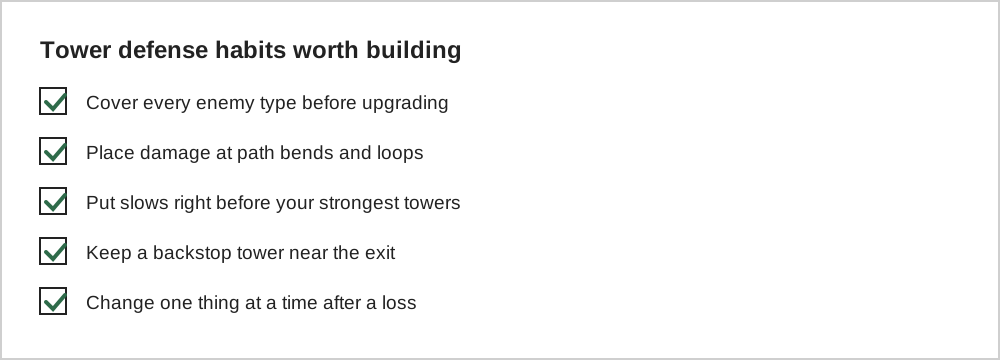
- Place damage towers where the path bends, so they can hit enemies on two stretches.
- Put slowing towers just before your strongest damage towers, so enemies spend more time in the kill zone.
- Avoid placing everything at the very start of the path. You want some coverage near the end as a safety net.
Know your enemy types
Most tower defense games mix several enemy types. Learning them is the fastest way to improve.
| Enemy type | Typical behaviour | Common answer |
|---|---|---|
| Fast | Rushes through range quickly | Slowing towers, towers with fast attack speed |
| Armoured | Resists small hits | High-damage or armour-piercing towers |
| Flying | Ignores ground-only towers | Anti-air or towers that can target air |
| Swarm | Many weak enemies at once | Area damage towers |
| Boss | Huge health, slow | Sustained single-target damage, slows |
When you lose a wave, look at which enemy type got through. That tells you what your defense is missing.
Spending: new towers or upgrades?
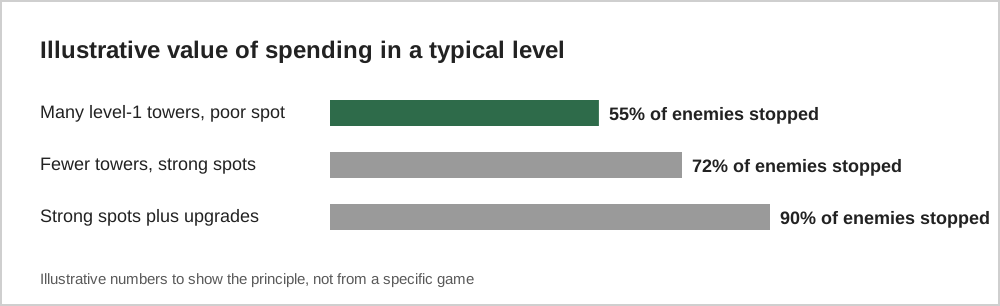
A useful rule is to cover all threats first, then upgrade. A single heavily upgraded tower can be overwhelmed if the game sends an enemy type it cannot target. Once you can handle every type, upgrades usually give more value per coin, especially for towers in strong positions.
Handling difficult waves
When a wave beats you repeatedly, change one thing at a time:
- Watch where enemies leak through and what type they are.
- Move or add a tower to cover that weakness.
- If the game allows, use special abilities at the start of the hardest wave rather than in a panic at the end.
- Replay with the same plan to confirm it works before changing something else.
Changing everything at once makes it hard to learn what actually helped.
Merge and idle variations
Many mobile tower defense games add merging, where two identical towers combine into a stronger one, or idle elements, where your defense keeps earning while you are away. The same principles still apply: positions with more path coverage are valuable, and you need answers for every enemy type. Merging adds a planning layer, because you need free space to combine towers efficiently. Keeping one or two slots empty for merging often pays off.
Upgrades outside a level
Many games have permanent upgrades, research trees or hero characters. These are where spending pressure usually appears, because a stronger permanent upgrade makes every level easier. Before buying anything, check whether the level you are stuck on can be beaten with a better layout. Often it can. Our guide to upgrade priorities has a general approach for permanent upgrades.
Common mistakes
The short version
Tower defense rewards thinking about space and time. Put towers where enemies stay in range longest, make sure every enemy type has an answer, and only then pour resources into upgrades. When a wave beats you, find out exactly what leaked through and fix that one weakness.