Events and Limited-Time Offers: How to Plan Instead of Panic
Limited-time events can multiply your progress, but countdown offers are built to rush decisions. How to plan for events and evaluate offers calmly.
Most live mobile games run a constant schedule of events: double-reward weekends, seasonal challenges, character banners and limited-time shop offers. Events are often the best time to make progress, but they are also the moments when games push hardest for purchases. A bit of planning helps you get the benefits without the pressure.
Types of events
| Event type | What it offers | How to approach it |
|---|---|---|
| Bonus multiplier | Extra rewards for normal play | Save energy or tasks for this window |
| Challenge or milestone | Rewards for reaching goals | Check how far free play gets you |
| Limited banner or summon | Featured characters or items | Decide in advance if you want it |
| Shop offer | Discounted bundles | Compare with normal prices |
Many events repeat
Live games tend to run events on a cycle. A seasonal event may return next year, a double-reward weekend may come back next month, and a "never again" offer often returns in a similar form. Community wikis and forums often track these patterns. Knowing that an event is likely to repeat removes much of the pressure.
Evaluating a limited-time offer
Countdown timers and "best value" labels are designed to speed up decisions. Slowing down is the best defence.
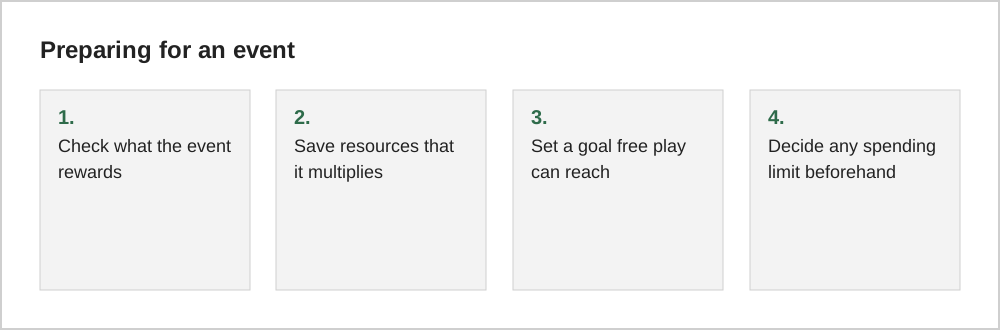
- Convert the price into real money and premium currency into its cash value.
- List what you would actually use from the bundle.
- Compare with the normal shop price of those items.
- Ask whether you would buy it without the countdown.
Event fatigue
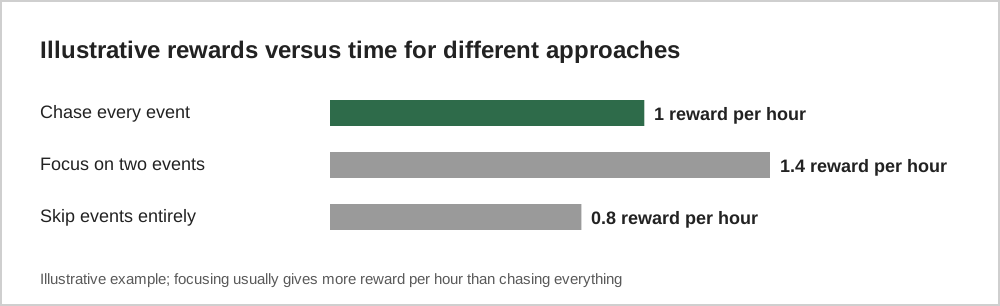
Overlapping events can make a game feel like a job. It is fine to skip events whose rewards you do not need. Picking one or two events per cycle and ignoring the rest keeps the game enjoyable.
A worked example
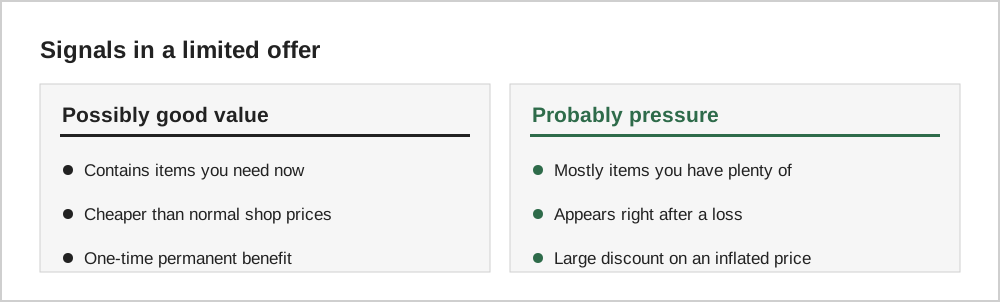
Suppose an event offers a bundle for $19.99 containing 2,000 gems, 10 summon tickets and an exclusive costume, with a banner claiming 800% value. The percentage usually compares the bundle with the most expensive way of buying the same items, not with what you would actually buy. Work out what the gems alone would cost in the standard shop and decide whether the extras are worth the difference to you.
Then ask whether you need any of it now. If the gems will sit unused until the next event, the urgency is mostly the countdown timer. A bundle that would still feel worthwhile without the timer is far more likely to be a good purchase.
Keeping an event calendar
Many games run events on a predictable cycle: seasonal holidays, anniversaries and regular collaborations. Note the dates of events you enjoyed and what was offered. After a few months you will see the pattern, and it becomes much easier to ignore a timer when you know a similar offer usually returns.
Common questions
How can I find out if an event will return?
Community wikis, official forums and social media posts often record past events and their schedules. Developers also sometimes announce reruns. If an event has run before, it is likely to return in a similar form.
Should I spend premium currency during events?
Events that multiply rewards for spending premium currency can be good value, but only if you would spend the currency anyway. Decide before the event begins how much you are willing to use.
Are event-exclusive items worth chasing?
Event-exclusive items are designed to feel rare, which makes them tempting. Ask whether the item improves your enjoyment or simply fills a collection. Collecting can be fun, but not every item needs to be owned.
The short version
Events are often the best time to progress, and many of them repeat. Prepare by saving the resources they multiply, decide spending limits before the event starts, and judge offers by real-money value rather than countdowns. Skip events that do not interest you; there will be another one soon.