Energy Systems and Timers: Why They Exist and How to Handle Them
Energy bars, lives and build timers limit how much you can play at once. How these systems work, why games use them, and how to keep them from running your day.
Many free mobile games limit how much you can play at once. You might have five lives that refill one at a time, an energy bar that drains as you play, or upgrades that take hours to finish. These systems can feel frustrating, but they make more sense once you understand their purpose.
Why games use timers
Timers serve several purposes at once:
- Pacing: they spread the game's content over days or weeks, so it lasts longer.
- Return visits: a refill or finished upgrade gives you a reason to come back.
- Revenue: you can usually pay to skip the wait, which is one of the main things free games sell.
The third point is why timers often appear at moments of high engagement, right when you want to keep going.
Common types
| System | How it works | Typical refill |
|---|---|---|
| Lives | Lose one when you fail a level | One every set number of minutes |
| Energy or stamina | Each action costs energy | Gradually over time |
| Build or research timers | Upgrades take real time | Fixed duration per upgrade |
| Daily attempts | A limited number of tries per day | Resets daily |
The cost of skipping
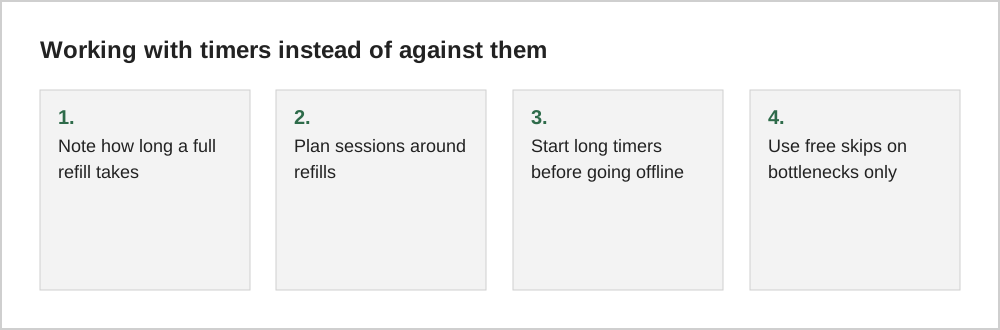
Skipping a timer with premium currency or a rewarded ad is not automatically bad. It becomes poor value when it is repeated often, because the cost adds up while the benefit, a few minutes or hours saved, is temporary.
Make timers work for you
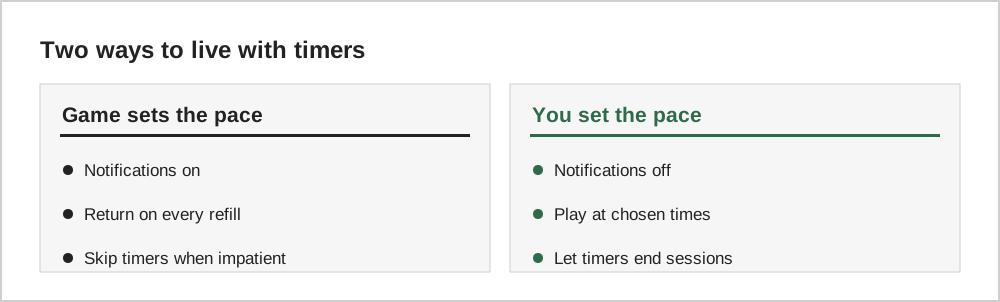
The healthiest way to treat timers is as natural stopping points. When your lives run out or your upgrade starts, the game is telling you that the session is over. Many players find games more enjoyable when they let timers end sessions rather than fighting them.
Notifications and timers
Games often send notifications when energy is full or an upgrade finishes. These are designed to bring you back quickly. You can turn them off in your phone's settings and simply check in when it suits you. Energy that sits full for a while is a small loss compared with an interrupted day.
A worked example
Suppose energy refills at one point every five minutes up to a maximum of 30, and each level costs 5 energy. A full bar allows six levels and takes two and a half hours to refill from empty. If you check in three times a day, you can play around eighteen levels without ever buying a refill.
Now suppose a refill costs 50 gems and gems cost roughly a cent each. Each refill is about fifty cents for six levels. Buying one occasionally is a small expense, but buying two a day adds up to about $30 a month. Knowing that figure in advance makes it easier to decide whether skipping the wait is worth it.
Timers and sleep
Some games set long timers to finish overnight and send a notification when they complete. If those notifications wake you or tempt you to play late, turn them off or schedule do-not-disturb. Long timers are designed to be checked at your convenience; there is rarely any penalty for collecting rewards in the morning.
Common questions
Why do some games give more energy at higher levels?
Many games increase your energy cap or refill rate as you progress, which keeps sessions feeling meaningful as content gets harder. It is part of the pacing design rather than a reward you need to buy.
Is changing the phone's clock to skip timers a good idea?
Many online games check time on their own servers, so changing the device clock usually does nothing, and it may break other apps or be treated as cheating. It is better to plan sessions around timers.
The short version
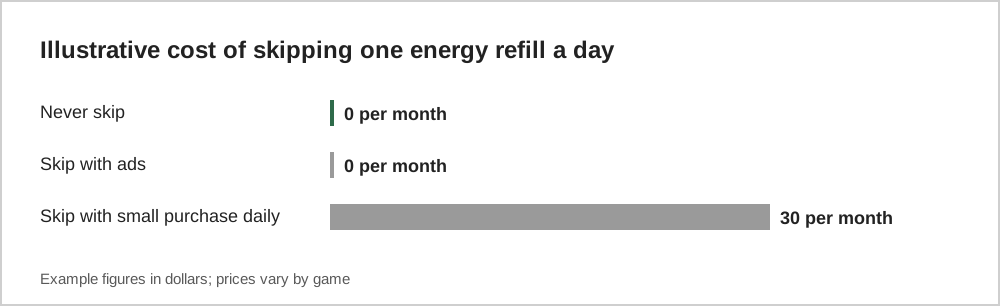
Timers pace a game, bring you back, and generate revenue through skips. Plan around them, start long timers before going offline, save free skips for bottlenecks, and let empty energy be a cue to stop rather than a reason to pay.