Loot Boxes and Drop Rates: How to Read the Odds Before You Buy
Random rewards, summons and loot boxes must show their odds on major app stores. How to read those numbers, what pity systems mean, and how to estimate real costs.
Loot boxes, gacha summons, card packs and prize wheels all have something in common: you pay for a random result. Because the outcome is uncertain, it is hard to know what you are really buying. Fortunately, the odds are usually published, and a little arithmetic turns them into something you can judge.
Odds disclosure on the app stores
Apple's App Store Review Guidelines require apps that offer loot boxes or other randomised virtual items for purchase to disclose the odds of receiving each type of item before purchase. Google Play's policies have a similar requirement. In practice, games usually show these odds on a "rates", "details" or "probability" screen near the purchase button.
Rules about loot boxes also vary by country. Some regulators have treated certain paid loot boxes as a form of gambling; Belgium is a frequently cited example. Because laws change, check current rules in your country if this matters to you.
Reading a drop-rate table
A typical table lists each rarity tier and its chance per pull.
| Rarity | Chance per pull |
|---|---|
| Common | 79% |
| Rare | 18% |
| Epic | 2.5% |
| Legendary | 0.5% |
The key number is the chance of the item you actually want. If there are several legendary items and you want one specific item, its individual chance is even lower.
Turning odds into expected cost
A simple estimate: on average, you need about 1 ÷ (chance) pulls to get one item. At 0.5%, that is around 200 pulls on average. Multiply by the cost of one pull and you have a rough average price.
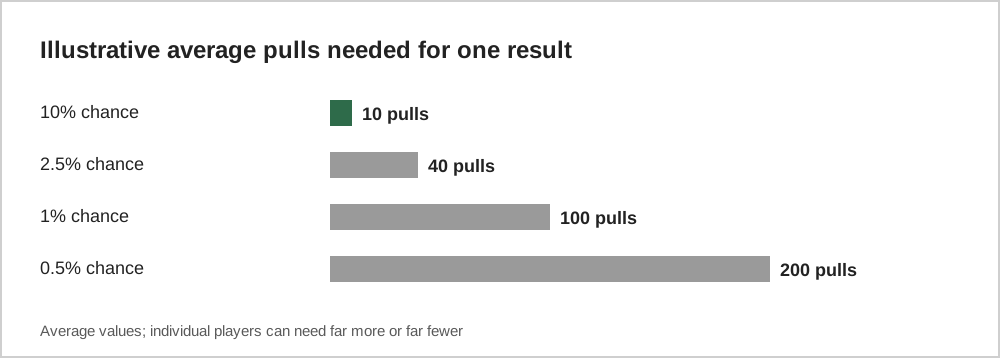
Averages hide a lot of variation. Some players get lucky early; others need much longer than the average. That variation is part of what makes random purchases feel exciting, and also what makes them expensive.
Pity systems change the maths
Many games include a "pity" mechanic: after a certain number of pulls without a rare result, one is guaranteed. A pity system sets a maximum cost, which is very useful to know.
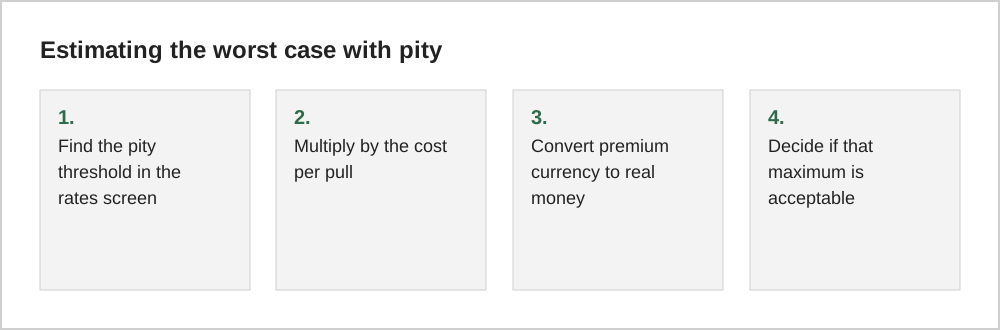
Some pity systems carry over between banners; others reset. Some guarantee a random rare item rather than the specific featured one. Read the details carefully, because they make a big difference to the real maximum cost.
Duplicates and conversion
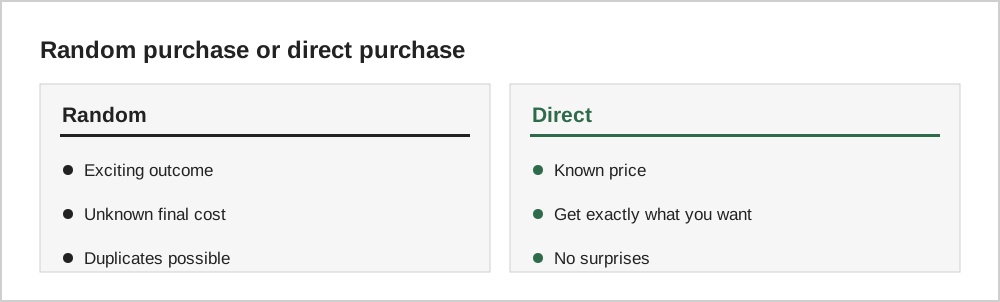
Many random reward systems give duplicates, which may convert into shards or currency. Games sometimes describe this as a safety net. It does reduce waste, but it rarely makes a random purchase as good as buying the item directly.
Children and random purchases
Random rewards can be especially hard for children to judge. Purchase approvals and spending limits help; see our parental controls guide.
Laws and regulation
Rules about loot boxes vary by country. Some require games to publish odds, some restrict paid random rewards for minors and some have considered or introduced broader limits. Both major app stores require games to disclose the odds of paid random items, which is why drop-rate tables have become common.
Because rules change, it is worth checking current guidance in your own country if you have concerns, especially for children. Regardless of regulation, the practical advice stays the same: read the odds, calculate expected cost and set a firm limit before you begin.
Talking to children about random rewards
Children often find it hard to judge chance. A simple explanation works well: imagine a bag with one gold marble and ninety-nine grey ones. Each purchase takes out one marble and puts it back. You might get gold quickly, or after a very long time. Framing it this way helps children see why spending can quickly add up.
Common questions
Do odds get better the more I buy?
Not unless the game says so. Each pull is usually independent, so previous bad luck does not make the next pull more likely to succeed. A pity system is the exception, and it is described in the rates or rules screen.
Are free loot boxes treated differently?
Rewards you earn through play without paying are generally treated differently from paid ones by regulators, and they carry no financial risk. The same odds-reading skills still help you decide whether to spend free premium currency on them.
The short version
Find the odds screen, focus on the chance of the specific item you want, divide one by that chance to estimate the average number of pulls, and use the pity threshold to work out the worst case. If the worst case is not acceptable, the safest choice is not to start.