Match-3 Puzzle Games: Strategies That Actually Help
Match-3 games look like luck, but move order, special pieces and level goals reward planning. Practical techniques for limited-move levels.

Match-3 puzzle games are among the most played mobile games in the world. You swap adjacent pieces to make lines of three or more matching pieces, which clear from the board. The simplicity is deceptive. Most levels have specific goals and a limited number of moves, and a little planning makes a big difference.
Read the goal before your first move
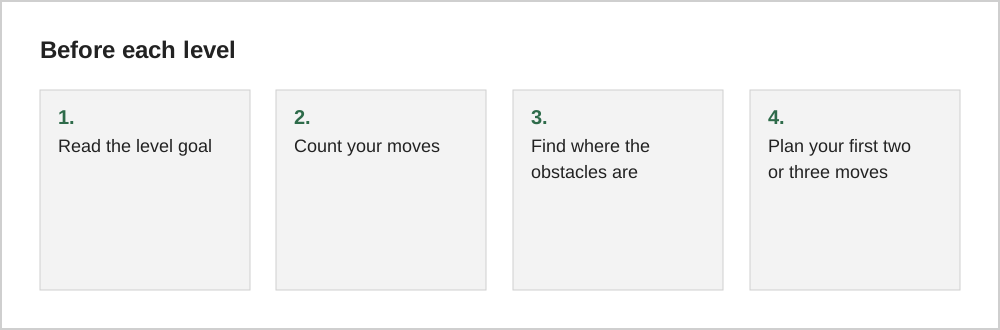
Each level usually has a specific objective: clear a number of a certain piece, break blockers, bring items to the bottom, or reach a score. It sounds obvious, but many failed levels come from making satisfying matches that do nothing for the goal.
Work from the bottom when possible
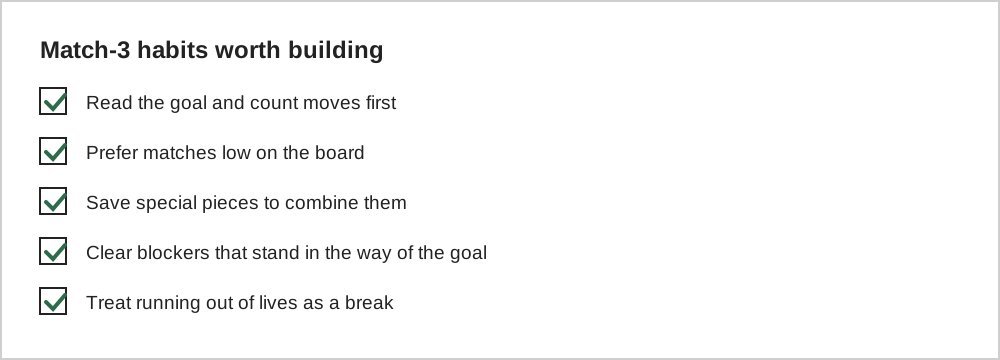
Matches near the bottom of the board cause pieces above to fall, which often creates new matches automatically. These "cascades" are free progress. Matches at the top rarely cause cascades. When you have a choice between two similar matches, the lower one is often better, unless the goal is at the top.
Know your special pieces
Matching more than three pieces usually creates a special piece. The exact names vary between games, but the patterns are similar:
| Match | Typical special piece | Effect |
|---|---|---|
| 4 in a line | Line clearer | Clears a row or column |
| L or T shape | Bomb | Clears an area |
| 5 in a line | Colour clearer | Removes every piece of one colour |
Combining two special pieces usually creates a much bigger effect. A line clearer swapped with a bomb, or two colour clearers swapped together, can clear large parts of the board. Saving special pieces until you can combine them is often stronger than using them immediately.
Handling blockers
Blockers such as ice, crates or chains stop pieces from moving or need several hits to clear. Most blockers are broken by matches made next to them or by special pieces. Prioritise blockers that are in the way of your goal or that stop pieces from falling into useful positions.
Boosters and extra moves
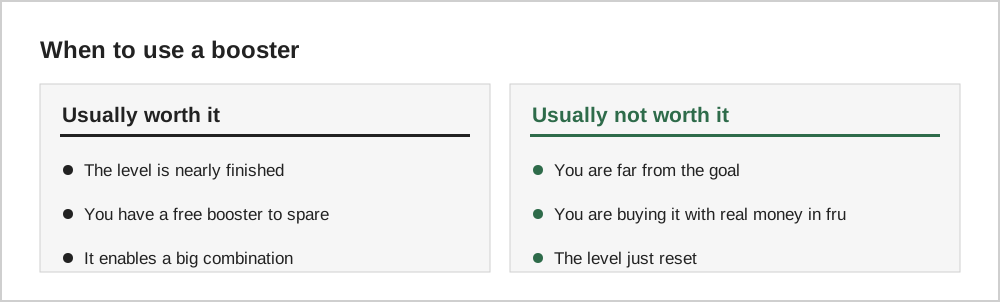
Many match-3 games offer boosters before or during a level, plus the option to buy extra moves when you run out. The extra-move offer appears at the moment you are most invested, which is a deliberate design choice.
A level you failed with five moves left will often feel easier on the next attempt, because the board layout changes each time.
Lives and timers
Many match-3 games give you a limited number of lives that refill over time. Running out is a natural place to stop. If you find yourself buying lives to keep playing, our guide on energy and timers explains why these systems exist and how to think about them.
A quick improvement checklist
A worked example of a tough level
Imagine a level with 20 moves, where you must clear 30 blockers mostly at the bottom of the board. Start by matching near the bottom, since cascades from lower matches shuffle new pieces in from the top and can create chain reactions. Save any special pieces you create for clusters of blockers rather than using them immediately.
If you reach the last five moves with many blockers left, combine two special pieces if possible; combinations usually clear much larger areas. If you still fail, look at the board layout on the next attempt and plan the first few moves before touching anything.
When to stop for the day
Match-3 games often place a very hard level after a run of easy ones, with offers for extra moves or boosters close by. If you fail the same level several times, close the game and come back later. A fresh board layout and a rested mind often solve what repeated attempts could not.
Common questions
Are some match-3 levels designed to be nearly impossible without boosters?
Some levels are noticeably harder than others, and difficulty can feel uneven. Because the starting board changes with each attempt, a level that seems impossible often becomes manageable after a few tries.
Is it better to play match-3 games quickly or slowly?
Slowly, in most cases. Since you usually have limited moves rather than limited time, taking a moment to scan the whole board for special piece combinations makes a bigger difference than speed.
The short version
Match-3 rewards reading the goal, matching low to create cascades, and combining special pieces instead of spending them at once. Use boosters when they finish a level, not when you are frustrated, and let lives running out be a natural pause.