How to Choose Your First Mobile Game (Without Wasting Hours)
A simple way to match a mobile game to the time you have, the way you like to play, and the amount you are willing to spend, before you download anything.
App stores make downloading a game feel free and instant, so most people pick games the way they pick snacks at a checkout: whatever is in front of them. The result is a phone full of half-started games and a vague feeling of wasted time. A few minutes of thinking before you install anything saves hours later.
This guide walks through three questions that matter more than star ratings or download counts: how much time you have, how you like to play, and how a game expects to be paid for.
Start with your time, not the game
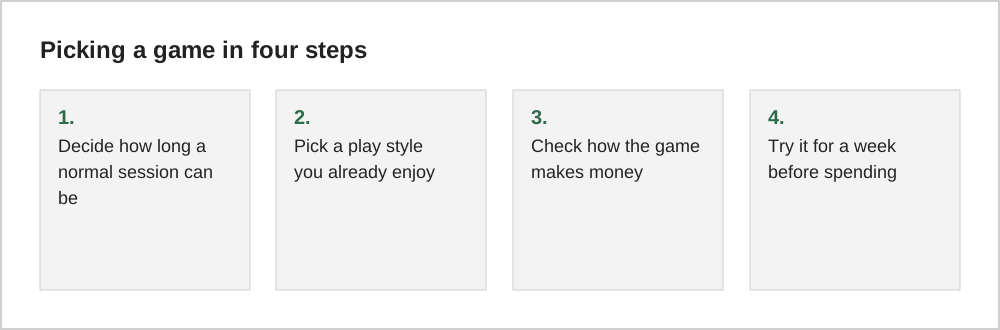
Mobile games are built around sessions. Some are designed for thirty-second bursts while you wait for a bus; others assume you will sit down for forty minutes and think. Choosing a game whose session length does not match your life is the most common reason people drop a game within a week.
| Your typical free time | Genres that usually fit | Genres that usually frustrate |
|---|---|---|
| A few minutes, many times a day | Match-3, word puzzles, idle games | Long strategy matches, story-heavy RPGs |
| 15 to 30 minutes in one go | Roguelikes, tower defense, card battlers | Games with strict daily timers |
| An hour or more, a few times a week | Strategy, RPGs, city builders | Games that punish missed days |
The last column matters as much as the middle one. Some games reward logging in every day and quietly penalise you if you do not. If your schedule is irregular, those games will feel like homework.
Match the play style you already enjoy
Think about games you liked in the past, on any device. Did you enjoy solving a puzzle, building something over time, outsmarting an opponent, or following a story? Most mobile genres lean heavily towards one of these.
- Puzzle lovers usually enjoy match-3, logic puzzles and word games.
- Builders tend to like city builders, farming games and idle games, where progress accumulates.
- Competitors gravitate towards card battlers, auto-battlers and real-time strategy.
- Story fans often prefer narrative adventures and premium RPGs.
Our genre guides explain what each of these asks of you in more detail.
Check how the game is paid for
The business model shapes the whole experience. A game you pay for once usually has no reason to slow you down. A free game has to earn money somehow, typically through ads, purchases inside the game, or a subscription.
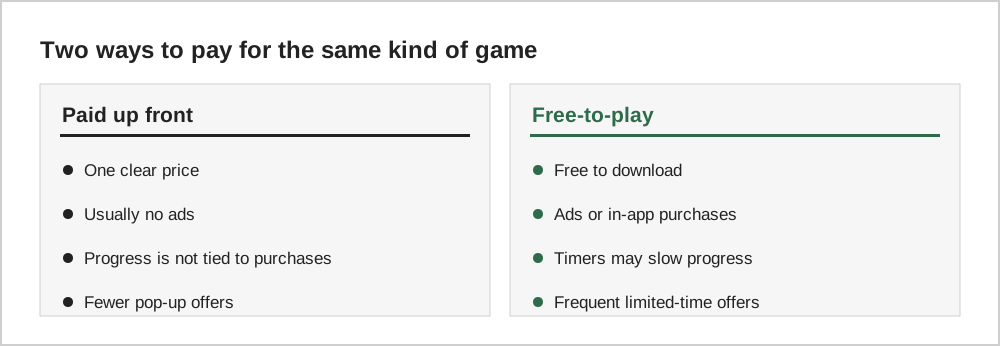
Neither model is automatically better. Many free games are generous and fun without spending anything. The point is to know what you are getting into. On the store page, look for the "In-App Purchases" or "Contains ads" labels, and scroll to the list of top in-app purchases if the store shows it. A game whose most popular item costs a large amount is telling you where its revenue comes from. Our guide on how free-to-play games make money explains the economics.
Look past the star rating
Star ratings are an average of very different experiences. A rating can be high because the first few hours are great, even if progress slows dramatically later. Instead of the average, read recent reviews with two or three stars. These tend to be written by people who liked the game enough to play it for a while and can explain what changed.
Give it a fair trial
Once you have a candidate, give yourself a short trial period with a few simple rules:
- Play for about a week without spending any money.
- Turn off notifications from the game so it cannot set your schedule.
- At the end of the week, ask whether you are still curious about what comes next, or just collecting daily rewards.
If the honest answer is the second one, uninstall it. A game you play only to avoid losing a login streak is costing you time without giving much back.
Keep the number of games small
It is tempting to install five games at once to see which one sticks. In practice, every free game competes for your attention with notifications, daily missions and events. Two or three active games is a comfortable number for most people. When you add a new one, consider removing an old one.
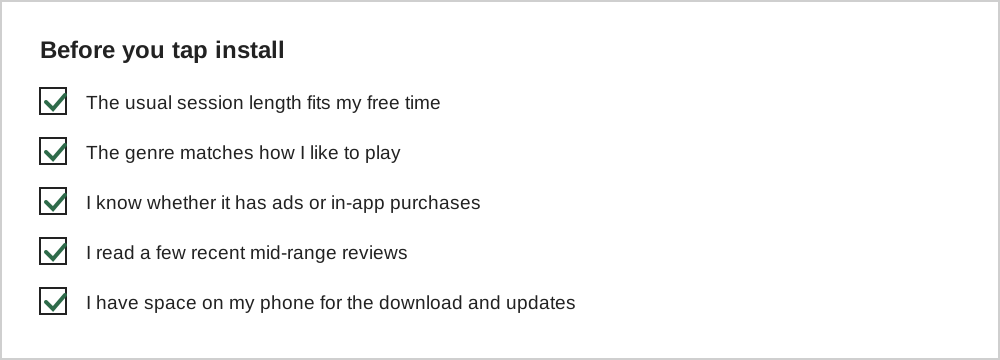
A quick checklist before you download
The short version
Choose for your time first, your taste second, and the business model third. Treat the first week as a free trial, keep notifications off, and keep your list of active games short. You will spend less time downloading and more time actually enjoying what you play.