How Free-to-Play Games Make Money (and Why It Matters to You)
Free games are paid for by ads, purchases and subscriptions. Understanding the business model explains timers, pop-up offers and difficulty spikes, and helps you stay in control.
Most of the top-grossing mobile games cost nothing to download. They still earn large amounts of money, and almost every design decision inside them is connected to how that money is earned. Once you understand the model, many of the things that feel random in a free game start to make sense: why a timer appears exactly when you are enjoying yourself, why a special offer pops up after a loss, and why the first hour is so generous.
This guide explains the main revenue sources in free-to-play games and what each one means for you as a player.
Three main sources of revenue
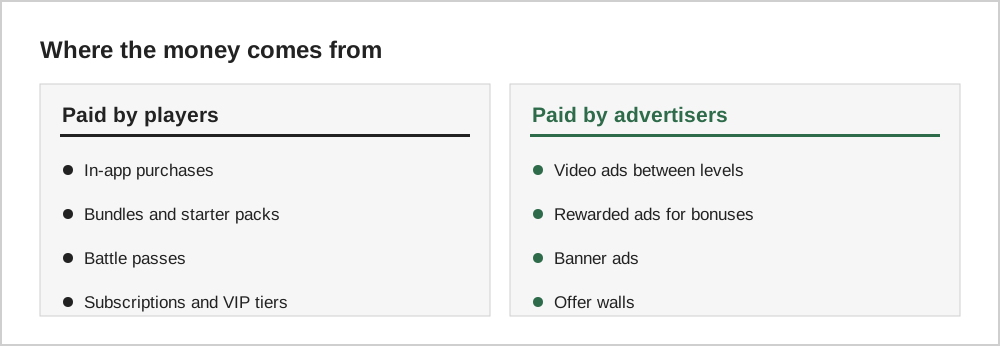
In-app purchases
In-app purchases sell items, currency or convenience inside the game. They range from a small pack of premium currency to large bundles. Because players can spend repeatedly, there is effectively no ceiling on how much one person can spend.
Advertising
Many casual games earn money by showing ads. Some are forced, such as a video between levels. Others are "rewarded ads", where you choose to watch an ad in exchange for an extra life or a bonus. Rewarded ads are generally less intrusive because you decide when to watch them.
Subscriptions and passes
Battle passes and monthly memberships charge a recurring or seasonal fee for a set of rewards. They are often cheaper per reward than one-off purchases, which is exactly why they are designed to be renewed. See our guide to battle passes.
Most players never pay
Industry reports have long found that only a small minority of players in a typical free-to-play game ever make a purchase, and an even smaller group accounts for a large share of revenue. The exact figures vary by game and genre, so treat any single number with caution, but the shape is consistent: the game is free for most people because a few people spend a lot.
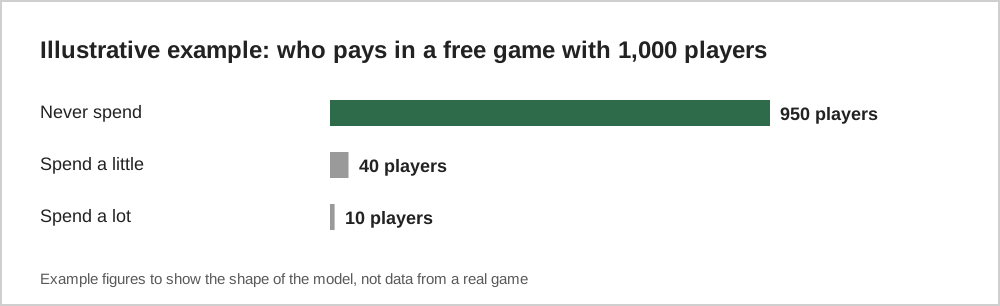
That shape explains a lot of design choices. Games are built to keep the non-paying majority playing, because they make the game feel alive and give spenders someone to play with, while offering paths for the most engaged players to spend more.
Design patterns to recognise
Knowing the patterns does not make a game bad, but it helps you notice when you are being nudged.
- A generous start. Early levels are quick and rewarding, so you form a habit before progress slows.
- Timers and energy. You can wait for a timer to finish, or pay to skip it. Our guide on energy and timers explains how they work.
- Premium currency. Prices are shown in gems or coins rather than money, which makes it harder to feel what you are spending.
- Limited-time offers. Countdown clocks create urgency. Most offers come back in some form.
- Offers after a loss. A discounted bundle appearing right after you fail a hard level is a common pattern.
Is free-to-play a bad deal?
Not necessarily. Many players enjoy free games for years without paying anything, and the people who spend are often happy with what they get. The model becomes a problem when spending is driven by pressure rather than choice: chasing losses, buying during a countdown, or paying to avoid missing out.
A useful rule of thumb is to decide on a budget before you open the game, not while you are playing it. Our guide on setting a game budget offers a simple method.
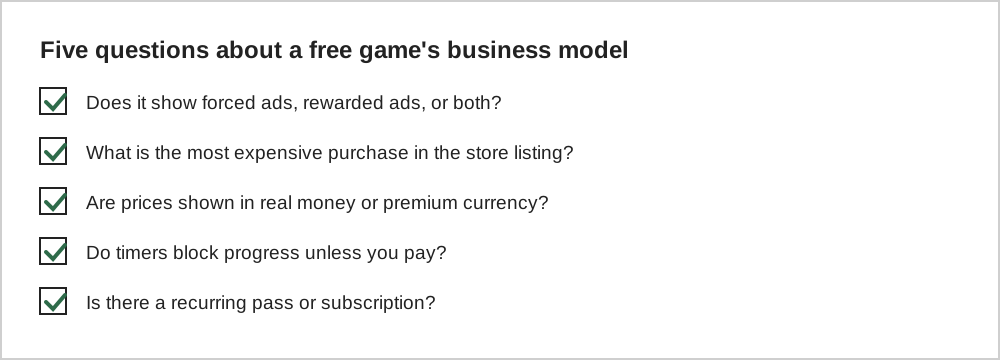
Questions to ask about any free game
How the model affects difficulty
In some games, difficulty rises sharply at points where a purchase would help. This is sometimes called a "pay wall", although many games let patient players get past it with time and practice. If you hit a wall, step back and ask whether you are still enjoying the game. If yes, try a different strategy or wait for events that give free resources. If not, it might simply be time to move on.
The short version
Free-to-play games are paid for by advertising and by a minority of players who spend money. That model explains timers, premium currencies and countdown offers. Knowing the patterns lets you enjoy free games on your own terms: set a budget in advance, convert prices into real money, and do not let a countdown make decisions for you.